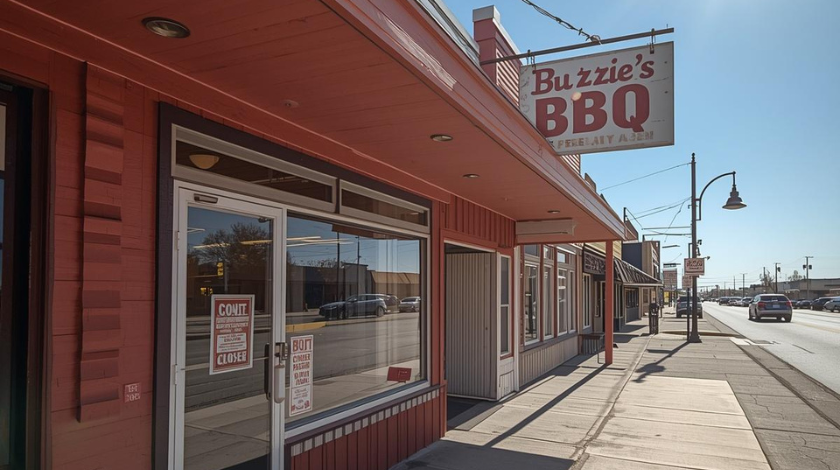
I still remember the exact moment I heard the news. I was scrolling through my phone on a hot August afternoon when the headline hit me like a splash of cold water: Buzzie’s Bar-B-Q in Kerrville had officially closed its doors for good. After 32 years of serving some of the most honest, unpretentious Barbecue in the Texas Hill Country, the legendary joint that once held the coveted title of Texas Monthly’s number one barbecue restaurant in the entire state was no more. The final service happened on August 3, 2025, and with it, an era of Texas barbecue history quietly came to an end.
If you’ve never driven through Kerrville, you might wonder why the closing of a single barbecue joint in a town of about 24,000 people matters so much. But for those of us who have made the pilgrimage to that unassuming building on the edge of the Hill Country, who have stood in line for brisket that was smoked over live oak for twelve hours or more, who have shaken hands with Harold “Buzzie” Hughes himself, this wasn’t just a business closing. It was like watching a piece of Texas heritage fade into memory. Buzzie’s wasn’t just a restaurant; it was a testament to what happens when passion meets patience, when a man decides that cooking meat over wood fire is more important than a comfortable corporate career.
The Official Closure: What Really Happened
The closure announcement came through local news outlets on August 5, 2025, though the final plates had been served two days prior. According to reports from the San Antonio Express-News and other Texas media outlets, the closure was immediate and permanent. No gradual wind-down, no “closing soon” signs to give loyal customers one last chance to say goodbye. Just done. Finished and thirty-two years of smoke and tradition, extinguished.
But here’s where the story takes an interesting turn that few people saw coming. The property itself didn’t sit empty for long. In a twist that speaks to the generosity of the Hughes family and their deep roots in the Kerrville community, the building and land were sold to Kerrville Pets Alive!, a local animal welfare organization. The group, which had lost its previous lease, now had a permanent home for its operations. So while the pits may have gone cold, the space would continue serving the community, just in a completely different way. There’s something poetic about that, a barbecue joint that fed thousands of people transforming into a place that saves animals.
The closure wasn’t entirely without warning if you knew where to look. Back in 2022, Brenda Hughes had posted on social media that the restaurant was temporarily closed due to staffing shortages, partially attributed to the lingering effects of COVID-19 on the restaurant industry. At that time, they hoped to reopen soon. But the challenges facing small, family-run barbecue joints in post-pandemic America proved too steep to overcome. The temporary closure became permanent, and the “until further notice” stretched into forever.
Who Was Buzzie Hughes? From Monsanto Engineer to Pitmaster Legend
To understand why Buzzie mattered so much, you have to understand the man behind the pit. Harold “Buzzie” Hughes wasn’t some culinary school graduate who decided Barbecue was trendy. He was a Kerrville native who started cooking over open flames when he was eight years old, back in 1965. While other kids were playing baseball or watching cartoons, young Buzzie was burning meat in backyards and down by the Guadalupe River, learning through trial and error what heat and smoke could do to a piece of beef.
For years, Barbecue remained a weekend hobby. Buzzie grew up, got a good job working for Monsanto in Austin at Fisher-Rosemount, and lived what most people would call a successful corporate life. But here’s where the story gets good. Every weekend, Buzzie would fire up his pits at home, and his coworkers would flock to his house to eat. We’re talking about a man so committed to feeding people that his weekends were spent in a cloud of smoke, serving brisket and ribs to anyone who showed up hungry.
His wife, seeing the mounting grocery bills and the exhaustion in her husband’s eyes, finally issued an ultimatum that changed Texas barbecue history: “Hey man, give it up. It’s getting too expensive. Open a restaurant.” So that’s exactly what Buzzie did. He quit his secure job at Monsanto, packed up his family, and moved back to Kerrville to open a barbecue joint in nearby Comfort, Texas, in 1993. Just like that, he went from chemical plant engineer to pitmaster entrepreneur. It was, as he later described it, a “leap of faith” where he “went for broke” without knowing what would happen next.
The Comfort location did well enough, but there weren’t enough people in that tiny town to sustain the business in the long term. Three or four years later, Buzzie opened a second location in Kerrville proper, and that’s where the magic really started happening. The Kerrville restaurant, which opened in 1997, became the flagship. When a fire burned out the pit room in 2008, Buzzie didn’t just rebuild; he upgraded. He gutted the building, brought everything up to code with fire brick and proper ventilation, and created one big, better space. The Comfort location closed in 2009, and all attention focused on Kerrville.
Texas Monthly, BBQ Pitmasters, and the Taste of Fame
Buzzie’s rise to statewide fame wasn’t accidental. In 2013, Texas Monthly barbecue editor Daniel Vaughn included Buzzie’s in the magazine’s prestigious Top 50 BBQ Joints list. For a small-town operation in Kerr County to make that list alongside Austin and Houston heavyweights was remarkable. It validated everything Buzzie had been saying about his cooking methods and brought food tourists from Dallas, Houston, and beyond to a town they’d never have visited otherwise.
But the real breakthrough came with television. Buzzie appeared on BBQ Pitmasters Season 4, the Destination America reality competition show that pitted pitmasters against one another in high-stakes barbecue battles. In his episode, Buzzie faced off against Will Fleischman of Lockhart Smokehouse in Dallas and Ernest Servantes of Burnt Bean Co. BBQ in New Braunfels. Using his signature brisket and a cowboy steak, Buzzie won the Texas championship on the show.
What made his victory particularly sweet was that Buzzie represented old-school Texas barbecue philosophy against more modern competition techniques. While other competitors used injections, phosphates, and wrapped meats in foil (the so-called “Texas crutch”), Buzzie stuck to his guns. “It all falls back to the old school – low fire, low heat, long cooking times,” he explained. “If you’ve got a good piece of meat and then you squirt it and juice it all up, what are you tasting? What’s a barbecue competition if you can’t taste the meat?” This philosophy resonated with purists and helped cement his reputation as a guardian of traditional methods.
The TV appearance brought immediate results. Business increased from customers all over the country who had seen the show and wanted to taste the real deal. People planned Hill Country vacations specifically around stopping at Buzzie’s. For a small business in a town of 24,000, that kind of exposure was transformative.
The Buzzie’s Method: Cooking with Conviction
Walk into Buzzie’s during its heyday, and you wouldn’t find fancy sides or trendy menu items. The offerings were simple: brisket, ribs, sausage, beans, potato salad, and coleslaw. That was it: no mac and cheese, no trendy tacos, no fusion experiments. Buzzie believed in doing a few things exceptionally well rather than many things adequately.
His cooking method was distinctive. He used only live oak wood, aged for at least 2 years until it was gray and the bark was falling off. The fire started hot, around 350 degrees Fahrenheit, to sear the fat cap on his briskets, which he always cooked fat-side up. As the cook progressed, the temperature would gradually drop to 225 or 200 degrees, allowing the collagen to break down slowly without drying out the meat. He never poked the meat with a fork, never used thermometers to check doneness. It was all touch, sight, and smell. “When they’re ready, they’ve got a certain smell to them,” he explained in his 2014 Texas Monthly interview.
This method requires patience that modern restaurants often can’t afford. A brisket might take 12 to 16 hours. You can’t rush it. You can’t speed it up for the lunch rush. “Barbecue is like wine,” Buzzie famously said. “You don’t pull a brisket before its time.” And he lived by another motto that should be embroidered on every aspiring pitmaster’s apron: “Cheap barbecue’s not good, and good barbecue’s not cheap.”
The results spoke for themselves. The brisket had a deep smoke ring, bark that crackled when you bit into it, and meat that pulled apart with gentle pressure but didn’t fall apart on its own. The ribs had that perfect tug where the meat comes clean off the bone without sliding off like it’s been boiled. It was Barbecue that tasted like Texas – unpretentious, substantial, and deeply satisfying.
Why Did Buzzie’s Close? The Hard Truth About Small-Town BBQ
The closure of Buzzie’s after 32 years wasn’t a failure of food quality or customer demand. When a restaurant closes after decades of success, the reasons are usually more complex than “the food got bad.” In Buzzie’s case, several converging factors made continuing impossible.
First, the staffing crisis that began during COVID-19 has never been fully resolved for many small restaurants. The 2022 temporary closure due to staffing shortages was a warning sign. Finding people willing to work the hours required in Barbecue – early mornings, hot conditions, physical labor – became increasingly difficult. When Buzzie’s couldn’t fully staff the restaurant, they couldn’t operate at the volume needed to remain profitable.
Second, the economics of small-town Barbecue have shifted dramatically. In his 2014 interview, Buzzie expressed concern about rising beef prices. “Now with beef prices the way they are, I don’t know what I’m gonna do. It’s scary now. I’m in a small community. I live on repeat business, so I’m not just here to take your money.” That was eleven years ago. Beef prices have only climbed higher since then, while small-town customers can’t absorb the kind of price increases that city barbecue joints charge. A place like Franklin Barbecue in Austin can charge $30+ per pound for brisket because tourists will pay it. In Kerrville, you have to feed locals who come back weekly, and they have budgets.
Third, the competitive landscape changed. Texas barbecue experienced a renaissance in the 2010s and 2020s, with new joints opening constantly and social media creating barbecue celebrities. While this raised the profile of Texas BBQ overall, it also meant that older, traditional joints had to compete with newer operations backed by investors, professional marketing teams, and modern amenities. Places like Burnt Bean Co. in Seguin (now the #1 spot on Texas Monthly’s 2025 list) represent a new generation of Barbecue that combines traditional methods with modern business practices.
Finally, family-run businesses face succession challenges. After 32 years, Buzzie himself was in his mid-60s. The physical toll of pitmaster life – the early mornings, the heat, the heavy lifting – becomes harder to sustain. Without a clear succession plan or the next generation ready to take over full-time, the logical choice becomes to close with dignity rather than let the quality decline.
Where to Get Your BBQ Fix in Kerrville Now
If you’re reading this with a sudden craving for Hill Country barbecue and a planned trip to Kerrville, don’t cancel your vacation. The town still has options, though none will exactly replicate Buzzie’s experience.
Bill’s Bar-B-Que is now the oldest continuously operating barbecue joint in Kerrville, with pits seasoned for over 40 years. Located on Highway 27 toward Ingram, Bill’s is open Tuesday through Saturday and emphasizes that their decades-old pits give their meat “the most distinctive taste newer restaurants can’t reproduce.” They source Texas meat and make everything from scratch. It’s a different style than Buzzie’s, but it carries that same sense of history and commitment to the craft.
True Texas BBQ and Dickey’s Barbecue Pit also operate in Kerrville, offering more options for visitors. While Dickey’s is a chain and lacks the independent character of Buzzie’s, it provides consistency and familiar flavors. True Texas BBQ offers another local option for those seeking Hill Country barbecue flavors.
For the truly dedicated, the broader Texas Hill Country barbecue trail offers world-class options within driving distance. Cooper’s Old Time Pit Bar-B-Que in Llano remains a legendary destination. Salt Lick BBQ in Driftwood continues to draw crowds. Opie’s BBQ in Spicewood offers excellent brisket and beef ribs. And if you want to see where Buzzie’s competitor, Ernest Servantes, ended up, Burnt Bean Co. in Seguin is now the top-rated barbecue joint in Texas, according to Texas Monthly’s 2025 list.
There’s also a silver lining for Buzzie’s fans: the food truck apparently still operates for special events. According to Yelp updates from early 2026, while the restaurant is permanently closed, the food truck makes appearances at special events, giving loyal customers occasional opportunities to taste that live oak-smoked brisket once more.
The Legacy: What Buzzie’s Meant to Texas Barbecue
When we talk about the legacy of a restaurant like Buzzie’s, we’re not just talking about the food, though the food was exceptional. We’re talking about the proof that a man with passion, patience, and a wood-fired smoker can build something that outlasts trends and transcends location. Buzzie Hughes took a childhood hobby, turned it into a career change in his 30s, and created a destination that brought people from across the country to a town they’d never otherwise visit.
Buzzie’s represented the democratization of great Barbecue. It wasn’t in Austin, Dallas, or Houston. It was in Kerrville, a city of 24,000. It proved that you didn’t need to be in a major city to make Texas Monthly’s top list. You didn’t need culinary school, investors, or a marketing team. You needed wood, meat, fire, and the willingness to wake up at 3 AM to tend your pits.
The restaurant also served as a mentor and inspiration. Buzzie’s stepson followed him into the business, learning everything he knew. The “German background” Buzzie mentioned – that Hill Country tradition of meat smoking and sausage making – continued through his operation. In a region where people still “butcher their own calves and hogs” and “process their own meat to save money,” Buzzie’s kept those traditions alive in a commercial setting.
Perhaps most importantly, Buzzie’s proved that authenticity has value in a world of shortcuts. When Buzzie competed on BBQ Pitmasters, he didn’t win by using the tricks and techniques that competition barbecue had become known for. He won by cooking the way he’d always cooked – with live oak, fat-side up, no injections, no foil. He let the meat speak for itself, and the judges listened.
The closure of Buzzie’s after 32 years is a reminder that even the best restaurants are temporary. Buildings get sold, pitmasters retire, and tastes change. But the impact of 32 years of excellent Barbecue doesn’t disappear when the doors close. It lives on in the memories of everyone who ate there, in the techniques Buzzie shared with others, and in the proof that small-town Texas can produce world-class food.
As the property transitions to its new life with Kerrville Pets Alive!, there’s a fitting symmetry. A place that once nourished the community through food will now save the community’s animals. The smoke may have cleared, but the spirit of service remains.
For those of us who made the drive to Kerrville, who stood in that line, who shook Buzzie’s hand and heard him say “Let her rip potato chip” before taking our order, the memory of that brisket – bark crackling, smoke ring deep, meat tender as a mother’s love – will remain. We didn’t just eat at Buzzie’s. We experienced what Texas barbecue is supposed to be.
Frequently Asked Questions
Q: When did Buzzie’s BBQ in Kerrville officially close? A: Buzzie’s Bar-B-Q officially closed on August 3, 2025, after 32 years of operation.
Q: Who was Buzzie Hughes? A: Harold “Buzzie” Hughes was the owner and pitmaster of Buzzie’s Bar-B-Q. He started cooking at age 8, worked as a Monsanto engineer before opening his first restaurant in 1993, and won the Texas championship on BBQ Pitmasters Season 4.
Q: Why did Buzzie’s BBQ close? A: The closure was due to a combination of factors, including staffing shortages that began during COVID-19, rising beef prices, the challenges of operating a small-town barbecue joint, and likely the physical toll of pitmaster life after 32 years.
Q: What happened to Buzzie’s BBQ property? A: The property was sold to Kerrville Pets Alive!, a local animal welfare organization that needed a permanent location after losing their lease.
Q: Is Buzzie Hughes still cooking Barbecue anywhere? A: According to Yelp updates from early 2026, while the restaurant is permanently closed, Buzzie’s food truck still operates at special events.
Q: What made Buzzie’s BBQ special? A: Buzzie’s used only aged live oak wood, cooked brisket fat-side up starting at 350°F and finishing at 225°F, and never used injections, phosphates, or foil. The menu was simple: brisket, ribs, sausage, beans, potato salad, and coleslaw.
Q: Was Buzzie’s BBQ ever ranked as the best in Texas? A: Yes, Buzzie’s was ranked as the #1 barbecue joint in Texas by Texas Monthly at one point and remained on their Top 50 list multiple times.
Q: Where can I get good Barbecue in Kerrville now? A: Bill’s Bar-B-Que is now the oldest BBQ joint in Kerrville (40+ years). True Texas BBQ and Dickey’s Barbecue Pit also operate in town.
Q: Did Buzzie Hughes win any barbecue competitions? A: Yes, Buzzie won the Texas championship on BBQ Pitmasters Season 4, beating competitors from Dallas and New Braunfels with his brisket and cowboy steak.
Q: What was Buzzie’s philosophy about Barbecue? A: Buzzie believed in traditional methods, saying, “Cheap barbecue’s not good, and good barbecue’s not cheap,” and “Barbecue is like wine. You don’t pull a brisket before its time”.
Read Also: Discovering Juanita’s Taqueria