
I still remember the first time I took my niece to the Great Plains Zoo. She was four years old, barely tall enough to see over the railings, and completely mesmerized by the Japanese macaques—the snow monkeys—soaking in their hot tub-like enclosure. “They’re just like people at the pool!” she shouted, pointing at a monkey with its eyes closed in pure bliss. That moment captured everything I love about this place. It is not the biggest zoo in America, and it does not have the flashiest marketing budget, but the Great Plains Zoo in Sioux Falls, South Dakota, creates these intimate, memorable moments that stick with you long after you have left the parking lot.
If you are planning a trip to Sioux Falls or you are a local looking for a weekend activity that actually engages your kids (and yourself), this guide will walk you through everything you need to know. I have visited this zoo at least a dozen times over the years, in every season from sweltering August afternoons to crisp November mornings, and I am going to share what works, what to skip, and why this 45-acre facility deserves more attention than it typically gets.
What Makes This Zoo Different From the Rest
Let us get one thing straight: the Great Plains Zoo is not the San Diego Zoo or the Bronx Zoo. It is a mid-sized facility with roughly 1,000 animals representing about 100 species. But here is the thing—sometimes smaller is better. You can walk the entire grounds in three hours without feeling exhausted, yet the animal density is surprisingly high. You are not hiking miles between exhibits or fighting through massive crowds to catch a glimpse of a sleeping lion.
The zoo has been accredited by the Association of Zoos and Aquariums (AZA) since 1991, and in 2016, it received the Quarter Century Award for 25 years of continuous accreditation. That matters because AZA accreditation is not just a sticker for the front gate. It means the facility meets rigorous standards for animal care, conservation, education, and safety. When you visit an AZA zoo, you are supporting an organization that contributes to real wildlife conservation, not just displaying animals for entertainment.
What really sets this place apart, though, is the collection of species you will not find just anywhere. The zoo houses red wolves, one of the most endangered mammals in North America, with fewer than 20 individuals left in the wild. They have Amur tigers, the largest big cat species on Earth, and a breeding pair of Eastern black rhinoceroses, part of a critical conservation program. These are not animals you see at every regional zoo, and the Great Plains Zoo has invested heavily in creating proper habitats for them.
Walking the Grounds: A Tour of the Exhibits
Let me walk you through what you will actually see when you visit, starting from the entrance and moving logically through the grounds. This is based on my most recent visit in early 2024, though exhibits do occasionally rotate.
The first thing you encounter after entering is the Japanese macaque exhibit, and honestly, it is one of the best monkey habitats I have seen anywhere in the Midwest. These snow monkeys have both indoor and outdoor spaces, but the highlight is their water feature. Japanese macaques are famous for sitting in hot springs during winter, and the zoo has recreated this with heated pools. In 2015, this exhibit won top honors from the AZA for design, and it is easy to see why. The viewing angles are excellent, and the monkeys are active and engaged. I have spent twenty minutes just watching them groom each other and play in the water.
Moving deeper into the zoo, you hit the Asian Cats complex. This was renovated in 2008 and features three species that represent the full size range of wild cats. The Amur tigers dominate the space physically—these cats can weigh over 600 pounds and stretch nearly 11 feet from nose to tail. When one of them walks up to the glass and looks at you, you feel it in your gut. Next door, the snow leopards demonstrate incredible camouflage against their rocky backdrop, and the Pallas’s cats look so much like oversized domestic cats that you have to remind yourself they are wild predators from the mountains of Central Asia.
The African Savannah section feels surprisingly expansive for a zoo this size. The giraffe enclosure allows eye-level interaction when the animals choose to approach the railing, and the Grevy’s zebras, with their narrow stripes, create a striking visual against the South Dakota sky. But the real star here is the black rhino habitat, opened in 2010 as “Rare Rhinos of Africa.” Black rhinos are critically endangered in the wild due to poaching, with fewer than 6,000 remaining. The Great Plains Zoo participates in the Species Survival Plan, a coordinated breeding program across AZA facilities, and they have successfully bred rhino calves here. Standing ten feet from a three-thousand-pound armored herbivore that represents one of the last of its kind is humbling.
In 2018, the zoo renovated its bear habitat into what they now call “Fortress of the Bears,” themed after Southeastern Alaska. They house both American black bears and brown bears, including a massive Kodiak brown bear weighing nearly 1,000 pounds. I happened to be visiting right when the zookeepers released the bears into their outdoor enclosure one morning, and watching that Kodiak emerge from its den and shake off the morning was like seeing a living tank roll out of a garage. The size is genuinely shocking in person—photos do not do it justice.
The Walkabout Australia exhibit, added in 2019, brings kangaroos, wallabies, emus, and New Guinea singing dogs to the eastern edge of the property. This is one of the more interactive areas; you can actually enter the wallaby enclosure and hope one hops close enough for a good look. The New Guinea singing dogs are a particular favorite of mine—these are wild canines that vocalize with a unique, melodious howl that sounds almost like a whale song crossed with a wolf call. They are rare in zoos and represent a species that may actually be extinct in the wild, with only captive populations remaining.
For families with younger children, the Hy-Vee Face-to-Face Farm is essential. This is the zoo’s petting zoo area, featuring rare breed goats, alpacas, Jacob’s sheep (which can have up to six horns), and various chickens. Kids can feed the goats, and there is something universally delightful about feeling a goat’s rough tongue pull pellets from your palm. My nephew spent 40 minutes here on our last visit, giving the adults a welcome break to sit on nearby benches.
The Delbridge Museum: A Complicated Legacy
No honest guide to the Great Plains Zoo can skip the Delbridge Museum of Natural History, even though it closed to the public in August 2023. Understanding what happened here is important for contextualizing the zoo’s evolution and its future direction.
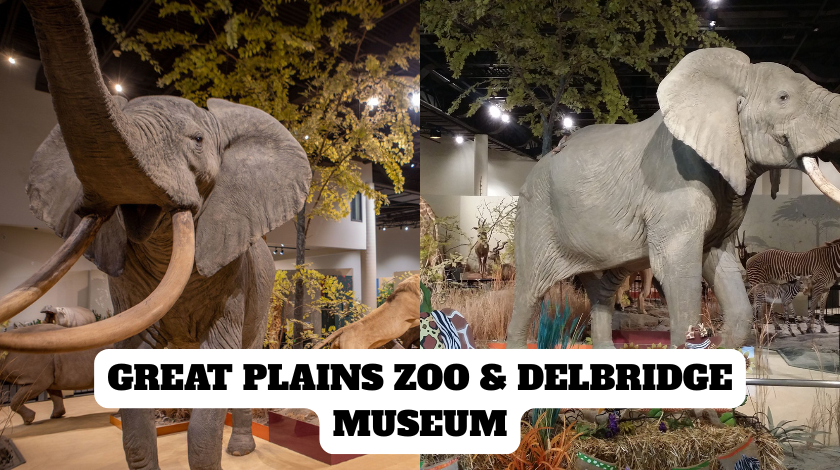
The museum opened in 1984 and is named after C.J. Delbridge, a Sioux Falls attorney who purchased a massive taxidermy collection at auction in 1981 for $550,000 and donated it to the city. The original collector was Henry Brockhouse, a local businessman who had amassed over 150 mounted animals from six continents during hunting expeditions from the 1940s through the 1970s. When you walked into the Delbridge Museum, you saw everything from African lions and polar bears to exotic birds and a giant panda, all preserved in dramatic poses.
For forty years, this collection served as an educational tool. School groups visited to learn about species they might never see alive. The “vanishing species” concept—38 of the mounts represented endangered or extinct animals—provided a sobering lesson about wildlife conservation. I visited the museum several times as a child in the 1990s, and I remember being simultaneously fascinated and slightly creeped out by the glass eyes staring back at me.
However, the closure in 2023 was inevitable once the zoo tested the specimens for chemical preservatives. Before the 1980s, taxidermists commonly used arsenic and asbestos to prevent insect damage and decay. While the museum had always posted “do not touch” signs and installed barriers, the reality is that curious children and occasional careless adults did touch the mounts. As the specimens aged and naturally degraded, the risk of chemical exposure increased.
The zoo leadership made the difficult yet correct decision to close the museum proactively. Testing revealed that even specimens that appeared to be in excellent condition contained detectable levels of these chemicals. The collection is now awaiting disposition through the U.S. Fish and Wildlife Service, as many of the species are protected under various conservation acts and cannot simply be sold or discarded. One specimen—the giant panda donated by the People’s Republic of China—will remain at the zoo in a sealed display case as a legacy piece.
This closure represents a transition point for the Great Plains Zoo. The space formerly occupied by the museum will eventually be repurposed as part of a master plan that includes integrating the Butterfly House & Aquarium, which merged with the zoo organization. While some locals mourn the loss of a childhood staple, the decision reflects modern standards of public safety and the zoo’s commitment to prioritizing the welfare of living animals over static displays.
Conservation Work That Actually Matters
It is easy to be cynical about zoos. I have heard the arguments—that they are prisons for animals, that they prioritize entertainment over welfare, that they contribute to the exotic pet trade. Some facilities absolutely deserve that criticism. But AZA-accredited zoos like the Great Plains Zoo operate on a different model, one that is increasingly focused on conservation breeding, habitat preservation, and public education that changes behavior.
The red wolf program exemplifies this. Red wolves once ranged across the eastern United States from Pennsylvania to Texas, but by 1980, they were extinct in the wild due to hunting and habitat loss. A captive breeding program saved the species from total extinction, and the Great Plains Zoo has participated in this effort. Today, wild red wolves exist only in a small reintroduction area in North Carolina, numbering fewer than twenty individuals. The zoo’s breeding pairs contribute genetic diversity to this fragile population.
Similarly, the Eastern black rhinoceros breeding program connects to real anti-poaching efforts in Africa. The zoo contributes funding and expertise to field conservation projects, and successful births here help maintain an insurance population against the possibility of wild extinction. When you buy a ticket to the Great Plains Zoo, a portion of that revenue supports these programs.
Educationally, the zoo runs ZooCamp programs throughout the summer that get kids hands-on with science. They are not just looking at animals; they are learning about ecosystems, food webs, and the human activities that threaten wildlife. The zoo also hosts “Party for the Planet” events around Earth Day and participates in the FrogWatch USA citizen science program. These initiatives turn casual visitors into environmental stewards.
Planning Your Visit: The Practical Stuff
Enough about the philosophy—let us talk logistics. The Great Plains Zoo is located at 805 S Kiwanis Avenue in Sioux Falls and is easily accessible from I-29. Parking is free and plentiful, which already puts it ahead of major city zoos, where you might pay $25 just to leave your car.
Hours vary seasonally, but generally the zoo opens at 10 AM and closes at 4 PM, with slightly later hours in summer. They are closed on Thanksgiving, Christmas, and New Year’s Day, but open year-round otherwise. This is worth emphasizing: visiting in winter is actually fantastic. The snow monkeys are in their element, the brown bears are often more active in cooler weather, and you will have the place nearly to yourself. Bundle up and enjoy the solitude.
Admission prices in 2024 are around $15 for adults and $11 for children, with discounts for seniors and military. Membership pays for itself if you visit more than twice a year, and it includes reciprocal benefits at other zoos nationwide. If you are visiting from out of town, consider the combination ticket with the Butterfly House & Aquarium, located about fifteen minutes away at Sertoma Park. This gives you two distinct experiences—terrestrial animals, tropical butterflies, and marine life—for one discounted price.
The zoo has a gift shop (Zootopia) and a cafe (Roar Café) with standard kid-friendly fare. You can bring your own food and picnic at tables throughout the grounds, which I recommend for budget-conscious families. The paths are mostly flat and stroller-friendly, though some areas get muddy after rain. Wear comfortable walking shoes.
One pro tip: the Africa area closes daily at 4 PM, which means the lions, zebras, and giraffes may not be viewable if you arrive late in the day. Plan to hit these exhibits early. Also, animals have access to indoor spaces and may choose to hide from public view—this is a feature of good welfare, not a bug. If the tigers are sleeping in their den rather than posing for photos, that means they have choices, which is exactly what we want for captive animals.
Why I Keep Coming Back
I have lived in the Midwest my entire life, and I have visited zoos from Chicago to Kansas City to Minneapolis. The Great Plains Zoo remains my favorite regional facility because it balances accessibility with genuine conservation impact. I do not need to navigate a city of millions to get there. I do not need to pay exorbitant parking fees or fight through tourist mobs. I can bring my family, spend a meaningful morning with animals that are clearly well-cared-for, and leave feeling like I supported something worthwhile.
My niece, now nine years old, still talks about that snow monkey in the hot tub. She has since learned that those monkeys are endangered, that their habitat in Japan is threatened by development, and that zoos like this one help fund protection efforts. That is the arc the Great Plains Zoo facilitates: from wonder to knowledge to action. In a world where wildlife is increasingly under pressure, facilities that create that progression are worth our time, money, and attention.
Conclusion
The Great Plains Zoo & Delbridge Museum represents the best of what a regional zoo can be—intimate, educational, conservation-focused, and genuinely enjoyable for visitors of all ages. While the Delbridge Museum’s closure marks the end of an era, the living animal collection continues to grow and improve. From award-winning snow monkey exhibits to critical breeding programs for red wolves and black rhinos, this facility punches well above its weight class.
Whether you are a Sioux Falls local looking for a weekend activity or a traveler passing through eastern South Dakota, set aside three hours for this zoo. Visit on a crisp fall morning when the bears are active, or on a snowy winter afternoon when you have the macaques’ hot tub all to yourself. Come with curiosity, bring your kids or your camera or just your walking shoes, and let yourself be surprised by how much this modest 45-acre campus has to offer.
Frequently Asked Questions
Is the Great Plains Zoo worth visiting? Absolutely. While it is smaller than major city zoos, the animal collection is diverse and well-presented, the grounds are walkable, and the conservation mission is legitimate. It is particularly valuable for families with young children who might be overwhelmed by larger facilities.
What happened to the Delbridge Museum? The museum closed in August 2023 after testing revealed that many of the taxidermy specimens contained arsenic and asbestos from historical preservation methods. The collection is being disposed of through the proper wildlife authorities, with only the giant panda specimen remaining for display.
How long does it take to visit the Great Plains Zoo? Plan for two to three hours to see everything comfortably. The 45-acre layout is compact enough to walk without exhaustion but dense enough to feel substantial.
What are the must-see animals? Do not miss the Japanese macaques (snow monkeys), the Amur tigers, the Kodiak brown bear, and the black rhinos. These are either award-winning exhibits or species rarely seen in smaller zoos.
Can you interact with animals? The Hy-Vee Face-to-Face Farm allows visitors to feed and pet goats, sheep, and other domestic animals. Other exhibits are view-only for safety and animal welfare.
Is the zoo open year-round? Yes, except for Thanksgiving, Christmas, and New Year’s Day. Winter visits offer unique advantages, including active snow monkeys and smaller crowds.