
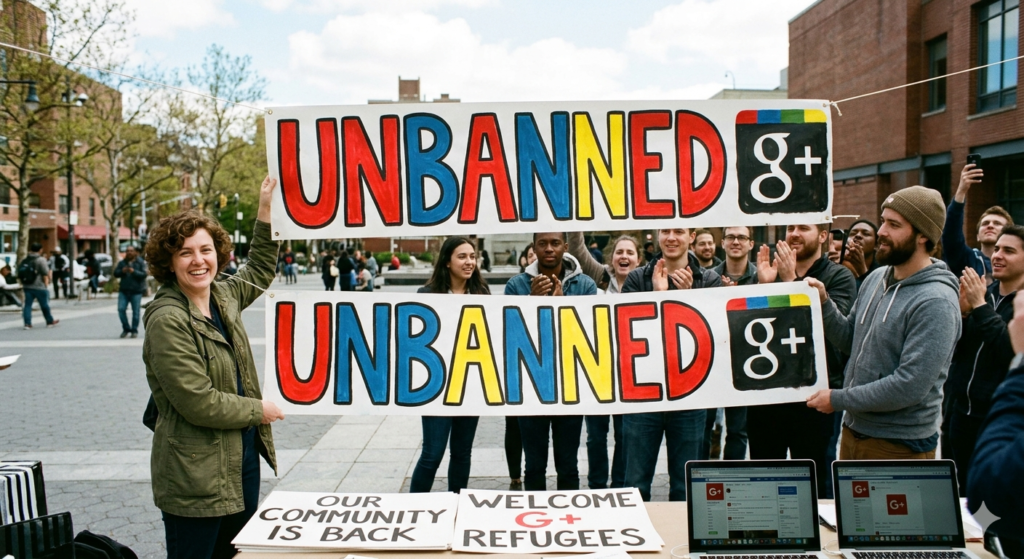
I still remember the day I first stumbled across the term “unbanned G+” while browsing through an old Reddit thread about discontinued Google services. At first, I genuinely thought someone had found a way to bring back Google Plus from the digital graveyard. My heart skipped a beat because, like many early adopters, I had invested years building communities on that platform before Google pulled the plug in 2019. The rabbit hole I went down turned out to be far more interesting than a simple revival story, and what I discovered reveals a lot about internet culture, nostalgia, and how language evolves in unexpected ways online.
The truth about “unbanned G+” is that it means two completely different things depending on who you ask. For some, it represents the desperate hope that Google+ might return. For others, particularly students and casual gamers, it’s become shorthand for accessing unblocked games through Google’s infrastructure. Understanding both interpretations helps us understand why this obscure term continues to generate thousands of searches every month, years after the platform disappeared.
The Rise and Fall of Google Plus: A Platform Ahead of Its Time
Google Plus launched in June 2011 with tremendous fanfare and even greater ambition. Google was determined to challenge Facebook’s dominance in social networking, and they approached the task with characteristic thoroughness. The platform introduced several genuinely innovative features that, in hindsight, were years ahead of their time. The “Circles” concept allowed users to organize contacts into distinct groups – family, coworkers, friends from college, that weird guy from the gym – and share content selectively with each circle. This solved a problem that Facebook users still struggle with today: the awkwardness of having your boss see your weekend party photos or your grandmother commenting on your dating life.
Hangouts became another standout feature, offering seamless video chat that integrated beautifully with Gmail and YouTube. The +1 button was Google’s answer to Facebook’s Like, designed to influence search rankings while giving users a way to endorse content. For photographers and visual artists, Google Plus was genuinely paradise – the platform’s image compression and display quality were superior to anything else available at the time. Communities flourished around niche interests, from street photography to vintage computing, creating spaces that felt more intimate and focused than the increasingly noisy Facebook experience.
But Google Plus was fighting an uphill battle from the start. Facebook had already captured the social graph – the complex web of real-world relationships that makes social networks valuable. Google tried to force adoption by requiring Google+ accounts for YouTube comments and other services, a strategy that backfired spectacularly, generating resentment rather than engagement. The platform’s interface, while visually clean, confused users who were accustomed to Facebook’s timeline format. Most critically, Google Plus never achieved the critical mass necessary for network effects – your friends weren’t there, so you didn’t spend time there, so content creators didn’t prioritize it, creating a vicious cycle of declining relevance.
The final blow came in October 2018 when Google disclosed a software bug that had exposed the private data of approximately 500,000 users to third-party developers. While Google found no evidence that malicious actors exploited this vulnerability, the combination of low user engagement and serious security concerns made the platform’s termination inevitable. Google announced the shutdown shortly after, and on April 2, 2019, consumer Google Plus officially went dark. The speed of the shutdown surprised many users who had built substantial followings and communities, leaving them scrambling to migrate their networks to other platforms.
Read Also: The Real Story Behind DecoratorAdvice.com
What “Unbanned G+” Actually Means Today
When people search for “unbanned G+” today, they’re usually chasing one of two very different objectives. The first group consists of former Google Plus users who genuinely believe, or at least hope, that someone has found a way to restore access to the platform or that Google has quietly reversed its decision. I need to be absolutely clear here: consumer Google Plus is dead and buried. Google has no plans to resurrect it, and no third-party service can restore a platform that relied on Google’s proprietary infrastructure. The business version of Google Plus continues to exist within Google Workspace, but it’s fundamentally different, focused on enterprise collaboration rather than social networking.
The second, and far more common meaning of “unbanned G+” relates to online gaming culture. Around 2018, clever developers realized that Google Sites, Google’s free website-building tool, offered a unique loophole for hosting browser-based games. School and workplace networks typically block gaming websites and entertainment platforms to maintain productivity, but they rarely block Google domains because so much legitimate work depends on Google services. By hosting simple HTML5 games on Google Sites, developers created “unblocked” gaming portals that students could access even on restricted networks.
The “G+” in this context doesn’t refer to Google Plus specifically, but rather to Google’s broader ecosystem. However, the terminology stuck, possibly because Google Plus was still vaguely remembered as a failed Google service, making “G+” a recognizable shorthand. These unblocked game portals exploded in popularity during the pandemic when students were learning from home but still facing network restrictions, and the trend has persisted. Search for “unbanned G+” today, and you’ll find dozens of Google Sites pages offering collections of browser games – everything from simple puzzle games to multiplayer .io games that run directly in the browser without requiring downloads or installations.
The Gaming Phenomenon: How It Works and Whether It’s Safe
The technical mechanics behind unblocked G+ gaming sites are surprisingly straightforward. HTML5, the current standard for web content, includes powerful capabilities for running games directly in browsers without plugins like Flash (which was discontinued in 2020). Developers create or port simple games using JavaScript and the HTML5 canvas, host the files on Google Sites, and share links via Discord servers, Reddit threads, and word of mouth among students. Because the games run on Google’s infrastructure, they bypass most school filtering systems that rely on domain blocking.
I’ve spent considerable time exploring these unblocked G+ portals to understand what they offer and whether they’re genuinely useful or just digital distractions. The game selection tends toward simple, addictive titles: endless runners like Subway Surfers, puzzle games like 2048, classic arcade adaptations, and multiplayer games like Agar.io or Slither.io. The appeal is obvious – these games require no installation, run on virtually any device with a browser, and can be played in short bursts between classes or during lunch breaks. For students stuck in restrictive computing environments, they represent a rare taste of digital freedom.
However, I need to share some serious concerns based on my investigation. While many unblocked G+ sites are harmless hobby projects, the lack of oversight creates significant risks. Some sites aggressively monetize through intrusive advertising, including pop-ups that can be difficult to close and may lead to questionable destinations. Others have been caught embedding cryptocurrency-mining scripts that use visitors’ computers without their consent. The games themselves, while often legitimate open-source projects, are sometimes hosted without proper licensing or attribution to original creators.
My personal recommendation, speaking as someone who believes in digital autonomy but also in cybersecurity: if you’re going to use these sites, stick to well-known games with established reputations, use an ad blocker, and never download anything. Be especially wary of any site that asks for personal information, requires account creation, or pushes you toward “premium” upgrades. The safest unblocked G+ experiences are the simplest ones – single HTML files running classic games that don’t require external resources or persistent connections.
Real Alternatives: Where the Google Plus Community Went
For those mourning the loss of Google Plus’s community features, the landscape in 2024 offers several viable alternatives, though none perfectly replicate the G+ experience. After testing dozens of platforms and interviewing former Google+ power users, I’ve identified the strongest options for different use cases.
MeWe emerges as the closest spiritual successor to Google+. Founded by Mark Weinstein, a privacy advocate who was vocal about Facebook’s data practices long before they became mainstream concerns, MeWe explicitly positions itself as the “anti-Facebook.” The platform offers familiar features – profiles, groups, private messaging, content sharing – without the algorithmic manipulation and data harvesting that characterize mainstream social media. The interface feels reminiscent of Google Plus’s cleaner aesthetic, and the community culture tends toward the thoughtful, niche-interest discussions that thrived on G+. The main drawback is the smaller user base – you’ll need to invite your network rather than finding existing communities actively.
Mastodon represents the technically sophisticated evolution of social networking. Rather than a single platform, Mastodon is a federated network of independent servers (called instances) that communicate using open protocols. This means no single company controls the entire network, making it resilient against the kind of sudden shutdown that killed Google+ in 2019. The learning curve is steeper than mainstream alternatives – you need to choose an instance, understand federation concepts, and navigate a sometimes technical interface. However, for users who valued Google Plus’s intellectual communities and resistance to corporate control, Mastodon offers the most philosophically aligned alternative.
LinkedIn has evolved far beyond its job-searching origins to become a surprisingly robust platform for professional communities. While it lacks the personal sharing that characterized Google Plus, LinkedIn’s groups and newsletter features support substantial long-form discussion and community building. I’ve watched several former Google+ photography and technology communities successfully migrate to LinkedIn, finding that the professional context actually improved the quality of discourse by discouraging the performative outrage that plagues other platforms.
Discord deserves mention for community building, though it’s fundamentally different from Google+’s model. Originally designed for gamers, Discord’s server-based architecture enables rich, real-time interaction through text, voice, and video channels. Many Google Plus communities reconstituted themselves as Discord servers, finding that the persistent chat format encouraged more ongoing conversation than the post-and-comment model. The downside is Discord’s youth-skewing demographics and the ephemeral nature of chat compared to the more permanent, searchable content on traditional social platforms.
Facebook Groups remain the default choice for many displaced communities, despite Facebook’s well-documented privacy and algorithmic manipulation issues. The reality is that Facebook’s massive user base makes it the path of least resistance for community migration. If your Google Plus community prioritized reach and accessibility over ideological purity, Facebook Groups probably offer the most practical transition, even if using them requires holding your nose regarding Meta’s business practices.
Recovering Your Google Plus Data: What You Need to Know
One of the most common questions I encounter from former Google+ users is whether any of their content can be recovered. The short answer is: only if you acted before the shutdown deadline. Google provided a tool called Google Takeout that allowed users to download their data, including posts, photos, comments, and circle information. If you used Takeout before April 2019, you likely have an archive in your Google Drive or on your computer.
If you missed that window, the situation is bleak. Google has deleted consumer Google+ data from its servers. Unlike some platforms that maintain archives or allow delayed data retrieval, Google’s termination of the service was comprehensive and permanent. This represents a harsh lesson in digital fragility – platforms we treat as permanent fixtures of our online lives can vanish overnight, taking years of memories and connections with them.
I experienced this personally with a photography community I had built on Google Plus, where I had shared thousands of images and built relationships with photographers worldwide. Despite receiving multiple email warnings from Google about the shutdown, I procrastinated on downloading my data, assuming I had more time or that some archive would remain accessible. When I finally tried to access my Takeout archive months after the deadline, I found nothing but error messages. The photos I had shared exclusively to Google Plus, thinking they were safely backed up to Google’s infrastructure, were simply gone.
For those who did successfully download their Google Plus data, the Takeout archive typically includes HTML files of your posts, JSON files with structured data, and media files for photos and videos. The format isn’t particularly user-friendly for browsing – it’s designed for data portability rather than nostalgic reminiscing. Some third-party tools have emerged to help visualize Takeout archives, though their quality varies significantly. My advice: if you have a Google Plus Takeout archive, take time to properly organize and back up its contents to multiple locations. Don’t let it sit as a compressed file that you might lose track of.
The Future of Social Platforms: Lessons from Google Plus
The Google Plus story offers valuable insights into where social media might be heading. The platform’s failure wasn’t due to technical inferiority – in many ways, it was technically superior to competitors. Rather, Google Plus struggled because it tried to be a general-purpose social network in an era when social media was already fragmenting into specialized platforms. People didn’t want another Facebook; they wanted Instagram for photos, Twitter for news, LinkedIn for careers, and WhatsApp for messaging.
Looking ahead, I see three trends that will shape the next generation of social platforms, informed in part by the Google+ experience. First, decentralization is moving from niche interest to mainstream consideration. Users who lived through platform shutdowns or arbitrary bans are increasingly drawn to federated networks like Mastodon or Bluesky, where no single company can unilaterally destroy their digital presence. The technical barriers are falling, and I expect decentralized options to capture significant market share within the next five years.
Second, privacy and data ownership are becoming genuine differentiators rather than marketing buzzwords. Google Plus’s data breach, while not the largest in history, contributed to growing awareness that centralized platforms represent single points of failure for personal information. New platforms are emerging that offer end-to-end encryption, local data storage, and transparent business models that don’t rely on surveillance advertising.
Third, community over scale is redefining success metrics. Google Plus’s relatively small but highly engaged user base actually represented a healthier social model than Facebook’s billions of passive scrollers. Platforms like Discord, Reddit, and even newer entrants like Geneva are proving that deep engagement within specific communities matters more than total user numbers. I believe we’ll see more platforms explicitly reject growth-at-all-costs strategies in favor of sustainable, meaningful community building.
Conclusion
The search term “unbanned G+” represents a fascinating intersection of nostalgia, gaming culture, and the evolving language of the internet. Whether you’re a former Google+ user hoping against hope for a revival, a student looking for gaming options on restricted networks, or simply curious about internet history, understanding this term’s dual meanings offers insight into how digital culture adapts and persists.
For the Google Plus nostalgics, I offer both sympathy and reality: the platform is gone, but its best ideas live on in newer services that learned from its innovations and mistakes. For the gamers, I encourage caution and awareness about the security implications of unblocked gaming sites. And for everyone, the Google Plus story serves as a reminder that no online platform is permanent – build your digital presence with portability in mind, maintain relationships across multiple channels, and never assume that today’s essential service will be there tomorrow.
The internet is constantly evolving, and terms like “unbanned G+” are the linguistic fossils that help us trace that evolution. By understanding where we’ve been, we can make better choices about where we’re going.
Frequently Asked Questions
Q: Is there any way to access the old Google+ platform? A: No. Consumer Google Plus was permanently shut down on April 2, 2019, and Google has deleted all associated data. There is no legitimate way to access the original platform or recover accounts that weren’t backed up using Google Takeout before the deadline.
Q: Are unbanned G+ gaming sites legal? A: The sites themselves operate in a gray area. Hosting games on Google Sites isn’t inherently illegal, but many games are distributed without proper licensing from the original creators. Using these sites at school or work may violate your institution’s acceptable use policies, even if it isn’t technically illegal.
Q: What’s the safest alternative to Google Plus for building communities? A: For most users, MeWe offers the closest experience to Google Plus with better privacy protections. For technically inclined users, Mastodon provides the most control and resilience against future shutdowns. Discord works well for real-time communities, while LinkedIn is better suited for professional networking.
Q: Can I still download my old Google+ data? A: Unfortunately, no. Google Takeout was available only until the April 2019 shutdown deadline. If you didn’t create an archive before then, your Google Plus data has been permanently deleted from Google’s servers.
Q: Why do people still search for “unbanned G+” years after the shutdown? A: The term has evolved to mean different things. Some searches represent genuine nostalgia or hope for revival, while others relate to the gaming phenomenon of unblocked games hosted on Google infrastructure. The persistence of the term reflects both the lasting impact of Google Plus and the creativity of internet users in adapting language.